Table of Contents
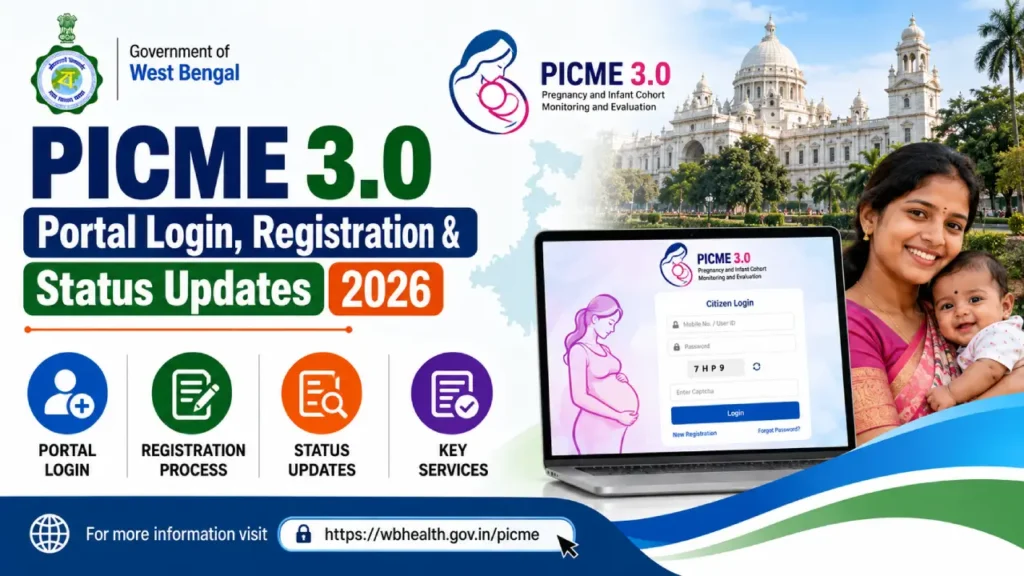
PICME 3.0 is Tamil Nadu’s upgraded pregnancy tracking and maternal welfare portal, and it is the single gateway through which expectant mothers in the state access the Dr. Muthulakshmi Reddy Maternity Benefit Scheme worth up to ₹18,000, obtain the mandatory 12-digit RCH ID, and secure their child’s birth certificate. For anyone navigating Tamil Nadu’s GOVT Schemes landscape, understanding how PICME 3.0 works is not optional — it is the first practical step toward receiving the financial and medical support the state provides.
With the system migrating to the new domain picme3.tn.gov.in, confusion has grown around login procedures, registration eligibility, and the exact benefits tied to the portal. This article provides a complete walkthrough of PICME 3.0: what it is, how to log in, how to register if you have not yet done so, and how it connects to the broader ecosystem of Tamil Nadu GOVT Schemes for maternal and child health.
What Is PICME and Why Does It Matter?
PICME stands for Pregnancy and Infant Cohort Monitoring and Evaluation. It is the official registration system of the Tamil Nadu government for identifying pregnant women, monitoring their health from conception through delivery and beyond, and connecting them to state welfare programs. The system was developed by the National Informatics Centre for the Department of Public Health and Preventive Medicine and has been operational since 2008.
The scale is significant. Each year, PICME registers approximately 11 lakh (1.1 million) expectant mothers across Tamil Nadu. The system provides user credentials to 8,713 Village Health Nurses (VHNs) in rural areas and 1,846 Urban Health Nurses (UHNs) in cities, creating a monitoring network that reaches the grassroots level.
The concept is straightforward: once a woman enrolls in PICME, a local health nurse is assigned to monitor her pregnancy, conduct antenatal check-ups, and intervene when complications arise. This proactive monitoring is designed to reduce maternal and infant mortality rates by detecting high-risk pregnancies early and ensuring timely medical attention.
But PICME is more than a health surveillance tool. It is the operational backbone of Tamil Nadu’s maternal GOVT Schemes. Without a PICME registration and the resulting RCH ID, a pregnant woman cannot access the state’s flagship maternity benefit program, and she will face difficulties obtaining a birth certificate for her child after delivery.
The RCH ID: Your Key to GOVT Schemes
The most tangible output of PICME registration is the 12-digit RCH ID (Reproductive and Child Health ID). This number is issued after a Village Health Nurse or Urban Health Nurse verifies the registered information. The RCH ID is unique to the mother and can be used across multiple pregnancies.
The RCH ID serves several critical functions:
It is the access credential for maternity benefits. The Dr. Muthulakshmi Reddy Maternity Benefit Scheme, Tamil Nadu’s flagship maternal welfare program, requires PICME registration and an RCH ID before any installment is released.
It is mandatory for birth registration. In Tamil Nadu, the RCH ID must be submitted when registering a newborn’s birth. The hospital uses it to link the child’s birth record to the mother’s health record built up through pregnancy. Without it, the birth certificate process is delayed or blocked entirely.
It links the mother to ongoing health services. The RCH ID connects the woman to antenatal care schedules, immunization tracking for the infant, and nutrition kit distribution through Anganwadi centers.
How to Log In to PICME 3.0
For users who have already registered — whether pregnant women, health nurses, or government officials — the login process is direct, provided you use the correct new domain.
Step 1: Visit the official website. Enter https://picme3.tn.gov.in in your browser. Do not use the older picme.tn.gov.in address for login, as the system has migrated.
Step 2: Locate the login button. On the homepage, find the “Login” option, typically positioned in the upper right corner or a prominent section of the page.
Step 3: Enter your credentials. Input your User ID (which may be your PICME number or RCH ID) and your password. Complete the captcha verification displayed on screen.
Step 4: Access your dashboard. Click “Submit” to enter the system. From the dashboard, you can view your pregnancy registration status, RCH ID, and related health records.
If you have forgotten your password, click the “Forgot Password” link on the login page and follow the recovery process using your registered mobile number.
How to Register If You Have Not Yet Enrolled
One of the most significant upgrades in PICME 3.0 is the introduction of public self-registration. Previously, pregnant women depended entirely on health workers or Anganwadi staff to enter their information. Now, married women can register themselves online.
The self-registration feature was introduced by the Tamil Nadu government in May 2025. Married women can register on the PICME website using their Aadhaar-linked mobile number and receive their RCH ID after verification. Women must provide their Aadhaar number, proof of residence, and medical details including proof of pregnancy.
A notable privacy feature: a woman may choose not to reveal the name of the father of the child. The website also allows the woman to change the name of the baby’s father in case of changes in her marital relationship.
Registration can be completed through multiple channels:
- Online self-registration at picme3.tn.gov.in
- Through your local Village Health Nurse (VHN) or Urban Health Nurse
- At government hospitals, primary health centers, or e-Seva centers
- By calling the 102 health helpline for assistance
Documents typically required include Aadhaar card, address proof (ration card or electricity bill), a passport-size photograph, a doctor’s certificate or scan report confirming pregnancy, and bank account details for benefit disbursement.
The Dr. Muthulakshmi Reddy Maternity Benefit Scheme: The Core GOVT Scheme Linked to PICME
The most consequential GOVT Scheme tied to PICME is the Dr. Muthulakshmi Reddy Maternity Benefit Scheme (MRMBS). Named after Tamil Nadu’s pioneering physician and social reformer, the scheme has operated in various forms since 1987, when it began with a cash disbursal of ₹200. It was enhanced to ₹6,000 in 2006, ₹12,000 in 2011, and ₹18,000 in 2018.
The scheme is designed to offset the nutritional and income costs that pregnant women face, while simultaneously incentivizing institutional deliveries and complete infant immunization. The cash is disbursed in installments tied to specific health milestones, creating a structured pathway through pregnancy and the child’s first year.
Installment Structure (Five-Installment Format)
The scheme has operated on a five-installment model, though government orders have revised the structure over time. The commonly cited breakdown is as follows:
| Installment / Benefit | Condition | Amount |
|---|---|---|
| 1st Installment | Antenatal registration on or before 12 weeks | ₹2,000 |
| 1st Nutrition Kit | Completion of third month | ₹2,000 (in kind) |
| 2nd Installment | After 4 months, subject to conditions in the Government Order | ₹2,000 |
| 2nd Nutrition Kit | Completion of fourth month | ₹2,000 (in kind) |
| 3rd Installment | After delivery in a government health facility | ₹4,000 |
| 4th Installment | After all 3 doses of OPV/Rota/Pentavalent and 2 doses of IPV | ₹4,000 |
| 5th Installment | After Measles-Rubella vaccination between 9th and 12th month of the infant | ₹2,000 |
Some sources describe a more recent three-installment structure: ₹2,000 at pregnancy registration, ₹4,000 at the seventh-month antenatal check-up, and ₹12,000 after delivery and BCG vaccination. Because the exact amounts and number of installments are set by government order and can change, beneficiaries should confirm current figures on the PICME portal or with their VHN.
Eligibility Conditions
The scheme is broadly universal for Tamil Nadu residents, with no income limit. Key conditions include:
- The mother must be a resident of Tamil Nadu
- Registration at a Primary Health Centre or through PICME should occur in the first trimester
- Completion of all required antenatal check-ups
- Delivery at a recognized institution (government or registered private hospital)
- The newborn must receive the prescribed vaccinations on schedule
Mothers with more than two children (HOB) and migrant mothers from other states have modified eligibility, typically receiving the first and fifth installments and nutrition kits subject to specific conditions.
The Thaimaaman Thanga Mothiram Thittam: A New GOVT Scheme Integrated with PICME 3.0
A recent addition to Tamil Nadu’s maternal welfare GOVT Schemes demonstrates the expanding role of PICME 3.0 as a digital infrastructure. The Thaimaaman Thanga Mothiram Thittam (TMTMT) was inaugurated in October 2026 as a welfare initiative celebrating the birth of children in government hospitals with a traditional gesture — a gold ring for the mother.
The National Informatics Centre developed an integrated web and mobile application for the TMTMT scheme that runs through PICME 3.0 integration, combining PDS e-KYC, Aadhaar-based biometric authentication, geo-tagged evidence, and QR-enabled ring tracking. This means the same RCH ID and maternal health record created through PICME registration now also serve as the verification pathway for this additional benefit, illustrating how PICME 3.0 is evolving from a pregnancy tracking tool into a broader platform for delivering maternal GOVT Schemes.
Birth Certificate: The Post-Delivery Requirement
The RCH ID obtained through PICME remains relevant after the child is born. Tamil Nadu requires the RCH ID to be submitted during birth registration. If the baby is born in a hospital, the hospital typically handles the birth registration with the local authority automatically, using the RCH ID provided by the mother. For home births, parents or relatives must inform the Village Administrative Officer or local birth registrar within 21 days.
The birth certificate can be downloaded from municipal or panchayat portals by searching with the baby’s name, mother’s name, RCH ID, date of birth, and hospital name. Within 21 days, there is typically no fee; delayed registration may incur late fees and require an affidavit.
For mothers who were not registered during pregnancy, it is still possible to register through PICME after delivery. Doing so before approaching the registrar avoids delays in birth certificate processing.
Common Pitfalls to Avoid
Several recurring issues can delay or block access to PICME-linked benefits:
Registering with a mobile number not linked to Aadhaar. Online self-registration depends on Aadhaar OTP verification. If the mobile number is not linked to Aadhaar, the OTP will not arrive. In this case, register through a PHC or the 102 call center instead of repeatedly retrying the online form.
Waiting past the first trimester. Several benefit installments and antenatal tracking milestones are tied to early registration, ideally within the first 12 weeks. Delaying registration does not disqualify you, but it can mean missing the earliest benefit window and the earliest round of risk screening.
Address mismatch. The address entered determines which PHC and VHN are assigned to the case. A mismatch can delay the verification visit needed to generate the RCH ID.
Not saving the pre-registration ID. This temporary ID is needed to check registration status before the RCH ID is generated. The mobile-number lookup on the status-check page can serve as a backup.
Assuming hospital delivery automatically updates benefit status. Post-delivery installments are typically tied to specific actions — institutional delivery, vaccination completion, and family planning procedures in some cases — that must be recorded in the PICME system. The mother should verify that the institution has made the required entries.
Conclusion
PICME 3.0 represents a significant evolution in how Tamil Nadu delivers maternal and child health GOVT Schemes. What began in 2008 as a pregnancy monitoring tool has become the digital backbone connecting expectant mothers to ₹18,000 in maternity benefits, mandatory birth registration, nutrition support, and emerging welfare programs like the Thaimaaman Thanga Mothiram Thittam. For pregnant women in Tamil Nadu, the practical takeaway is clear: register early, use the correct portal at picme3.tn.gov.in, keep your RCH ID accessible, and verify that your bank account details are correctly entered. The system is designed to support you — but it requires your participation to function.
wedadmin
Scheme Expert & Senior Writer
Expert in government schemes and welfare policies with years of experience in public policy research.